Impedance Spectroscopy
Evgenij Barsoukov's
collection of impedance spectroscopy resources
Index
- Ph.D. Dissertation "Impedance spectroscopy investigation of redox kinetics of conducting polymers"
- Abstracts and full-text papers of Evgenij Barsoukov
- Abstracts and ref. numbers of patents of Evgenij Barsoukov
- Impedance Fitting Programs: download / request links and comparative analysis
Abstracts and full-text papers of
Evgenij Barsoukov
(full-text links to be added soon)
G.S.Popkirov, E. Barsoukov, "In situ
impedance measurements
during oxidation and reduction of conducting
polymers:
significance of capacitive currents",
J. Electroanal. Chem. 383 (1995) 155
Abstract:
An attempt has been made to model mathematically
the capacitive component of the current obtained in cyclic voltammograms of
polymer-coated electrodes. The capacitance data used were obtained by means of
electrochemical impedance spectroscopy (EIS) measurements performed in situ
during the potential sweeps. It was shown that the capacitive current flowing
during the oxidation and reduction processes strongly depends on both the low
frequency capacitance of the polymer and its changes during the sweep.
____________________________________________________________________________________
G.S. Popkirov, E. Barsoukov and R.N.
Schindler "Electrochemical
impedance spectroscopy of twin working
electrodes bridged with
conducting polymer layer", Electrochim.
Acta 40 (1995) 1857
Abstract:
A new technique is described for electrochemical
impedance spectroscopic (EIS) investigations in the plane of a polymer layer
coating an electrode without crossing the interface polymer-electrolyte. For
this purpose a twin-working electrode configuration was constructed, that
consists of two practically identical electrodes with a gap of a few
micrometers width between them. This gap was bridged by a polymer layer of
polybithiophene. Its behavior was studied during electrochemical deposition on
the twin electrode and during transition from insulating to conducting state
upon oxidation. It is shown that for lower frequencies the impedance spectra
obtained depend predominantly on the polymer conductivity and are not
determined by the macroscopic external polymer/electrolyte interface.
Contribution of capacitive ac currents that cross microscopic internal
polymer-electrolyte interfaces in the deep pores of the polymer become
considerable only in the higher frequency range.
_____________________________________________________________________________________
G.S. Popkirov, E. Barsoukov and R.N.
Schindler
"Investigation of conducting polymer
electrodes
by impedance spectroscopy under galvanostatic
conditions"
J. Electroanal. Chem., 425 (1997) 209-216
Abstract:
Electrochemical impedance spectroscopy was used
to investigate the electrochemical polymerization of bithiophene under
galvanostatic conditions. The impedance spectra obtained on layers with
different thicknesses were analyzed by a fitting procedure, based on
theoretical models known from the literature. It was shown that the model of Ho
at al. (C. Ho, I.D. Raistrick and R.A. Huggings, J.Electrochem. Soc., 127
(1950) 343) can be applied successfully in studying the impedance spectra of
relatively thin polybithiophene layers, deposited at low current density. The
model of Paash at al. (G. Paasche, K. Micka and P. Gersodorf, Electrochim.
Acta, 38 (1993) 2653) in a simplified form is better suited to describe the
spectra of thicker, supposedly porous polymer layers, obtained at higher
current density. It was suggested that the deposition of polymer film onto a
metal electrode follows a 3D growth mechanism during the first stages of
polymerization, and pseudo-2D growth form polymerization at charges higher than
15 to 20 mC/cm-2. Important parameters of the polymer film, such as the
apparent diffusion coefficient, apparent diffusion length, ionic and polymer
layer thickness were estimated.
_____________________________________________________________________________________
Jong Hyun Kim, Jong Hun Kim, Evgenij
Barsoukov, Chul Oh Yoon, and Hosull Lee
“Li NMR Study of Li Intercalated Carbons
Prepared by Electrochemical Method”, Mol.Chyst.Liq.Cryst. 310 (1998) 297
Abstract:
Li solid-state nuclear magnetic resonance (NMR)
is employed to investigate the mechanism of electrochemical
lithium-intercalation in various carbon materials. Multiple resonance line
shapes observed in fully lithiated carbons indicate that several intercalant
sites exist under distinct spin-interaction environment, and they are
substantially dependent upon physical nature of host structure. The temperature
dependence of resonance spectra in disordered carbons prepared at relatively
low carbonization temperature considerably differs from that observed in
lithiated carbons with graphite structure.
_____________________________________________________________________________________
Evgenij Barsoukov, Jong Hyun Kim, Jong Hun
Kim, Chul Oh Yoon, and Hosull Lee
“Effect of Low-Temperature Conditions on Passive
Layer Growth on Li Intercalation Materials: In sity Impedance Study”, J.Electrochem.Soc.
145/8 (1998) 2711.
Abstract:
Electrochemical impedance spectroscopy has been
applied to investigate the formation of insulating layers at the surfaces of
microscopic particles of mesocarbon microbeads (MCMB), graphite and hard carbon
during the first Li-intercalation into these materials at ambient temperature
as well as at -20 oC. Investigations were carried out in a 3-electrode sandwich
cell, designed for impedance measurements in the frequency range 64kHz-5mHz.
The impedance spectra, obtained in the potential range 1.5 and 0.02 V during
the first charge, were analyzed by complex non-linear least square fits. A new
model, taking into account the porous structure of the intercalation material,
electrochemical processes at the interface, as well as spherical diffusion of
Li ions toward the centers of the particles, has been used for this analysis.
First intercalation at -20oC results in formation of an insulating layer, which
is about 90 times thinner than in the room temperature case, as concluded from
the analysis of experimental results. The irreversible capacity loss, which is
1.3 times larger at -20 oC than at room temperature, is ascribed to the
formation of a porous precipitate of electrolyte decomposition products on the
particle surface. Additional reduction at room temperature results in
irreversible capacity loss of 26% from the initial value, and formation of a
composite layer, including low-temperature and room-temperature deposited
components.
_____________________________________________________________________________________
Evgenij Barsoukov, Jong Hyun Kim, Chul Oh
Yoon, and Hosull Lee
“Kinetics of lithium intercalation into carbon anodes:
in sity impedance investigation of thickness and potential dependence”, Solid
State Ionics, 116 (1999) 249.
Abstract:
Electrochemical impedance spectroscopy (EIS) in
3-electrode sandwich configuration was applied to investigate the kinetics of
Li intercalation into mesocarbon-microbeads (MCMB) based anodes. A new
frequency domain model, considering porous macroscopic structure of the active
material and spherical diffusion inside the particles, has been applied to
analyze the potential and thickness dependence of impedance spectra. Values of
several kinetics-relevant parameters like specific conductivity of the layer of
intercalation material (2.6 10-4 S cm-1), chemical diffusion coefficient of
Li-ions in MCMB (2.2 10-9 cm2 sec), charge transfer resistance (184 ? cm2), are
obtained from the analysis. Applicability of proposed model to prediction of
time-domain charge curves has been tested using numerical inversion of
_____________________________________________________________________________________
Chul Oh Yoon, Hyun Kyung Sung, Jong Hun Kim, Evgenij Barsoukov, Jong Hyun Kim, Hosull Lee, “The effect of low-temperature conditions on the electrochemical polymerization of polypyrrole films with high density, high electrical conductivity and high stability”, Synthetic metals, 99 (1999) 201.
Abstract:
High-quality polypyrrole-hexafluorophosphate
(PPy-PF6) films with high density (~1.4 g/cm3), high conductivity (>300 S/cm
for unstretched film) and high electrochemical stability are obtained
reproducibly by galvanostatic polymerization at low-temperature conditions. The
optimal polymerization current density of Jp=0.02-0.05 mA/cm2 was obtained at
the polymerization temperature of Tp=-40oC. The surface morphology of the film
sensitively varies depending upon the properties of electrode and its surface
conditions. The transport measurements characterize the high-density PPy-PF6
film as a disordered metal close to the boundary of disorder induced
metal-insulator (M-I) transition. The X-ray diffraction measurements suggest
that partially crystalline structure of PPy-PF6 film is related to the transport
properties. The uniaxial stretching induces an increase of the conductivity up
to ~930 S/cm in a direction parallel to stretching as well as the anisotropy of
conductivity. The comparative studies of thermogravimetric analysis (TGA),
cyclic voltammetry (CV) and electrochemical impedance spectroscopy (EIS) for
PPy-PF6 films prepared at room-temperature and low-temperature conditions show
that the latter exhibit better thermal stability as well as electrochemical
stability under long oxidative polarization.
_____________________________________________________________________________________
Evgenij Barsoukov, Jong Hyun Kim, Chul Oh Yoon, and Hosull Lee, “Universal battery parameterization to yield a non-linear equivalent circuit valid for battery simulation at arbitrary load”, J.Power Sources, 83 1/2 (1999) 61
Abstract:
A method of numerical representation for
electrical storage cells based on measurement of wide frequency range impedance
spectra at a number of different states of charge and measurement of the
depth-of-discharge dependence of equilibrium voltage are developed.
Applicability of this method to batteries with various chemistries and sizes
are established by comparing numerical prediction to experiment. The model
represents all tested batteries with accuracy (less than 1% in average
deviation) in processes ranging from time constants of 1 ms to 10 h and from
current densities of C/10 to 3C. The method includes the fitting of impedance
spectra to physically relevant static linear transmission-line model and the
use of parameters determined at different discharge levels to create a
non-linear dynamic model. Formalization of the model as a non-linear equivalent
circuit enables its direct application as a part of any electric device in
digital circuit simulators like SPICE.
_____________________________________________________________________________________
Evgenij Barsoukov, Jong Hyun Kim, Dong Hwan Kim, Chul Oh Yoon, and Hosull Lee, “Parametric analysis using impedance spectroscopy: relationship between material properties and battery performance”, Journal of New Materials for Electrochemical Systems, 3, (2000) 303-310.
Abstract:
The possibility of prediction of battery
material performance based on parameterization of impedance spectra measured at
different states of charge in boundaries of non-linear equivalent circuit model
(numerical image) is demonstrated. An impedance parameterization procedure
developed in this laboratory was used to obtain all kinetically relevant
parameters of LiCoO2 based composite Li-ion battery cathode materials. The
accuracy of performance prediction was tested by comparing voltage profiles,
calculated on basis of numerical image, at discharge rates ranging from 1/10C
to 3C with experimental data. Model parameters were used to compare the
relative influence from different kinetic steps on discharge behavior of
composite electrode. Predicted thickness dependence of electrode impedance was
compared with experimental impedance spectra measured on samples with active
material thickness from 20 to 60 ?m. The change of relative contributions of
kinetic parameters with thickness has been investigated.
_____________________________________________________________________________________
Evgenij Barsoukov, Jee Hwan Jang, and Hosull
Lee
"Measurement of Li-ion batteries thermal
impedance spectrum using heat-pulse response analysis", J. Power Sources,
109 (2002) 313
Abstract:
A novel characterization of thermal properties
of battery has been introduced by defining its frequency-dependent thermal
impedance function. Thermal impedance function can be approximated as a thermal
impedance spectrum by analyzing experimental temperature transient which is
related to the thermal impedance function through
In order to obtain temperature transient, a
process has been devised to generate external heat pulse with heating wire and
to measure the response of battery. This process is used to study several
commercial Li-ion batteries of cylindrical type. The thermal impedance
measurements have been performed using potentionstat/galvanostate controlled
digital signal processor, which is more commonly available than flow-meter
usually applied for thermal property measurements.
Thermal impedance spectra obtained for the
batteries produced by different manufactures are found to differ considerably.
Comparison of spectra at different states of charge indicates independence of
thermal impedance on charging state of battery. It is shown that thermal
impedance spectrum can be used to obtain simultaneously thermal capacity and
thermal conductivity of battery by non-linear complex least-square fit of the
spectrum to thermal-impedance model.
_____________________________________________________________________________________
Evgenij Barsoukov, Jee Hwan Jang, and Hosull
Lee
"Eectrochemical impedance spectrometer
based on carrier function Laplace-transform", J. Electroanal. Chemistry,
536/1, (2002), 109
Abstract:
A novel impedance spectrometer has been
developed to obtain good quality spectrum for electrochemical cell or device in
the minimum time required by Nyquist theorem for the lowest frequency in
spectrum. The new method based on a simple instrumental design resolves the
known problems of existing methods such as long measurement time and fairly
complicated design of frequency response analyzer (FRA), as well as poor
quality of obtained spectrum for pulse-response analysis based systems.
The spectrometer applies a simple excitation
such as current pulse, instantly connected resistance, or current interrupt,
followed by measurement of response such as voltage or current against time.
The response is fitted to an analytical function (carrier function), and the
values of parameters obtained in the fit are applied to the expression of
analytical
_____________________________________________________________________________________
E. Barsoukov?, D.H. Kim, H.S. Lee and H. Lee
(1); Marina Yakovleva, Yuan Gao and John F. Engel (2),
“Comparison of kinetic properties of LiCoO2 and
LiTi0.05Mg0.05Ni0.7Co0.2O2 by impedance spectroscopy”, Solid State Ionics,
submitted (2002)
(1) Kumho Chemical Laboratories, Korea Kumho
Petrochemical Company
57-1 Hwaam Yuseong, Daejeon 305-348, Rep. of
Korea
(2) FMC Corporation
Abstract
New material based on LiNiO2 with some nickel atoms
substituted for other metals has become increasingly popular as cathode
materials for Li-ion battery due to higher capacity of LiNiO2 compared to
traditionally used LiCoO2 and improved material stability and safety due to
substitutes. However, rate capability of new materials was not extensively
researched. Purpose of this investigation was to characterize by impedance
spectroscopy all major kinetic steps of Li-intercalation into conventional
LiCoO2 and substitution stabilized material LiTi0.05Mg0.05Ni0.7Co0.2O2 samples,
provided by FMC Corporation. Very wide frequency range of impedance
measurements (to 200 ?Hz) with acceptable duration was made possible by using
Kumho Chemical Laboratories one-shot FFT-impedance spectrometer. Availability
of such low frequency data allowed confident estimation of diffusion and
phase-change kinetic parameters. Results were analyzed in terms of
transmission-line model considering composite structure of electrode. Effects
of particle size and mechanism of samples degradation with cycling were also
investigated.
_____________________________________________________________________________________
Abstracts and full-text patents of
Evgenij Barsoukov
"Method and apparatus for measuring
battery capacity by impedance spectrum measurement" Kumho Petrochemical,
by C.O.Yoon, E.Barsoukov, J.H.Kim, Korean Patent No. 264515 (00/6/1),
Japan Patent No. 3162346 (01/3/23), US Patent No. 6208147 (01/3/27)
Yoon , et al. March 27, 2001
Method of and apparatus for measuring battery
capacity by impedance spectrum analysis
Abstract
Provided with a method of measuring battery
capacity by impedance spectrum analysis, which is to measure a characteristic impedance
spectrum of primary and secondary batteries and determine the battery capacity
the method including the steps of: (1) measuring the characteristic impedance
spectrum of a battery in a predetermined frequency region; (2) determining a
parameter from the measured impedance spectrum; (3) monitoring in advance the
correlation between the determined parameter and the battery capacity measured
by a real-time discharge technique; and (4) determining the battery capacity
from the characteristic impedance spectrum of a battery having an unknown
capacity based on the monitored correlation.
____________________________________________________________________________________________________________________________________
Inventors: Yoon; Chul Oh (Taejeon, KR);
Barsukov; Yevgen (Taejeon, KR); Kim; Jong Hyun (
Assignee: Korea Kumho Petrochenical Co.,
Ltd. (Chongno-ku)
Appl. No.: 260438
Filed: March 2, 1999
"Method of and apparatus for measuring battery capacity using voltage response signal based on pulse current", Kumho Petrochemical, by C.O.Yoon, E.Barsoukov, J.H.Kim, Korean Patent No. 262465 (00/5/2), Japan Patent No. 19234A2 (00/1/21), US Patent No. 6118275 (00/9/12), PCT Application No. 66340A1 (99/12/23, 7 countries including EU, Canada, Israel and Taiwan)
Yoon , et al. September 12,
2000
Method and apparatus for measuring battery
capacity using voltage response signal based on pulse current
Abstract
A method of measuring battery capacity using a
voltage response signal based on a pulse current, where the method includes the
steps of: measuring a voltage response signal based on a pulse current signal
applied to a primary or secondary battery; performing an approximation of the
measured voltage response signal to an equivalent circuit model composed of
resistors, capacitors and transmission lines to determine the model parameters;
and determining the unknown battery capacity from the voltage response
characteristics based on a correlation between the measured capacity and the
model parameters, which correlation is previously determined by a real-time
discharge method, thereby takes a shorter time than a real-time discharge
method and delivering efficiency and reliability in determining model parameters
of an equivalent circuit which are in close correlation with the
charge/discharge condition of the battery.
____________________________________________________________________________________________________________________________________
Inventors: Yoon; Chul Oh (Taejeon, KR);
Barsukov; Yevgen (Taejeon, KR); Kim; Jong Hyun (
Assignee: Korea Kumho Petrochemical Co.,
Ltd. (
Appl. No.: 216181
Filed: December 18, 1998
"Battery parameterization system"
Kumho Petrochemical, by C.O.Yoon, E.Barsoukov, J.H.Kim, Korean Patent
Application No. 98-49700 (98/11/19), Japan Patent No. 3190313 (01/5/18),US
Patent No. 6160382 (00/12/12), PCT Application No. 31557A1 (00/6/2, 16
countries including EU, Canada, Israel and Taiwan)
Yoon , et al. December 12,
2000
Method and apparatus for determining
Characteristic parameters of a charge storage device
Abstract
A method and an apparatus for determining
characteristic parameters of a charge storage device based on a wide frequency
range of impedance measurement and a non-linear equivalent circuit model by
which the parameters of the non-linear equivalent circuit model indicative of
the characteristics of various charge storage devices such as a primary battery,
secondary battery, capacitor, supercapacitor and fuel cell are determined, the
method comprising the steps of: (1) measuring voltage and current
characteristics in a process of charging/discharging of the charge storage
device by applying a voltage/current at a predetermined discharge rate; (2)
measuring impedance spectra at a predetermined range of frequency by measuring
the current and voltage from both terminals of the charge storage device or
from an electrical load directly connected to the charge storage device at a
plurality of states of charge within the entire charge/discharge interval; and
(3) obtaining the parameters of the non-linear equivalent circuit of the charge
storage device from the charge or discharge characteristics measured in step
(1) and the characteristic impedance spectrum in the predetermined range of
frequency measured in step (2).
____________________________________________________________________________________________________________________________________
Inventors: Yoon; Chul Oh (Taejeon, KR);
Barsukov; Yevgen (Taejeon, KR); Kim; Jong Hyun (
Assignee: Korea Kumbho Petrochemical Co.,
Ltd. (
Appl. No.: 358264
Filed: July 21, 1999
"Laplace transform impedance spectrometer" Kumho Petrochemical, by C.O.Yoon, E.Barsoukov, J.H.Kim, Korean Patent Application No. 8460 (99/3/13), Japan Patent No. 3069346 (00/5/19), US Patent Application No. 746452 (99/12/30), PCT Application (15 countries including EU, Canada, Israel and Taiwan) in process
Abstract
This disclosure describes a method of
measuring impedance based on carrier function
____________________________________________________________________________________________________________________________________
"Method to obtain performance characteristics of electrochemical power source by multidimensional correlation of parameters obtained by measurement", Kumho Petrochemical, by H.K.Sung, E.Barsoukov, J.H.Jang, Korean Patent Application in process, US Patent Application in process
Abstract
A method of obtaining performance characteristic
such as but not restricted to state of charge, state of health, manufacturing
quality (grade), cycling life etc. of electrochemical power sources such as
primary battery, secondary battery or fuel-cell by multidimensional (also known
as multi-variant) correlation between the desired performance characteristic
and 2 or more parameters obtained from test measurements performed on the
multiple entities of power source having different values of the performance
characteristic to be obtained. Test measurement which results are used to
obtain parameters employed by this method has to be of shorter time duration or
less destructive then the direct measurement of desired performance
characteristic, such as but not restricted to impedance measurement.
Method includes: (a) performing test measurements
on multiple power sources of same design but with different values of desired
performance characteristic; (b) performing direct measurement of the desired
performance characteristic on all electrochemical power sources for which test
a) was performed; (c) obtaining 2 or more parameters p1,p2...pN for each of
tested power sources by analysis of the results of test measurement performed
in a); (d) performing multi-dimensional correlation between the desired
performance characteristic and parameters obtained in c) using suitable
means such as but not restricted to localized multi-variant regression to
obtain set of regression parameters k1,k2...kN which define multidimensional
functional or algorithmic dependence in form V=f(p1,p2...pN, k1,k2...kN) where
V is the desired performance characteristic and p1,p2...pN are parameters
obtained in c); (e) Performing same test measurement as in (a) on power source
with unknown performance charachteristic; (g) obtaining from test measurement
results set of 2 or more parameters u1,u2...uN using same method as in c); (h)
substituting the obtained in (g) parameters u1,u2...uN into multidimensional
functional or algorithmic dependence obtained in (d) and calculating the
desired performance characteristic V1=f(u1,u2...uN,k1,k2...kN);
____________________________________________________________________________________________________________________________________
"Method for grouping quality of batteries to build optimal packs using pattern matching technology of impedance spectrum", Kumho Petrochemical, by H.K.Sung, E.Barsoukov, J.H.Jang, Korean Patent Application in process, US Patent Application in process
Abstract
Method to assign single cells of power sources
to several groups in order to improve performance of cell-packs made of cells
residing in one group as compared to packs made of randomly selected batteries
using parameters obtained by equivalent circuit analysis of impedance spectrum
as criterion of grouping. .
Method includes: (a) Performing impedance
spectra measurement measurements on statistically representative number of
power sources of same design but with different values of performance.
Impedance spectra are measured at several frequencies in frequency range
sufficient to obtain parameters of chosen equivalent circuit used for analyzing
the spectrum.; (b) finding resistive and capacitate parameters of an equivalent
circuit by fitting the measured impedance spectra to known impedance function
of the equivalent circuit. Equivalent circuit is chosen so that it allows best
possible extrapolation of experimental data to 0 frequency; (c) Using one or
several of obtained parameters to calculate approximation of the total
resistance (real part of impedance at zero frequency, or DC resistance). (d) Assigning
all batteries intended for making battery packs to several groups distinguished
by similarity of the value of total resistance obtained in step d.
Selection of group ranges is optimized based on known distribution of the total
resistance value of the cells.
Impedance Fitting Programs:
download / request links and comparative analysis
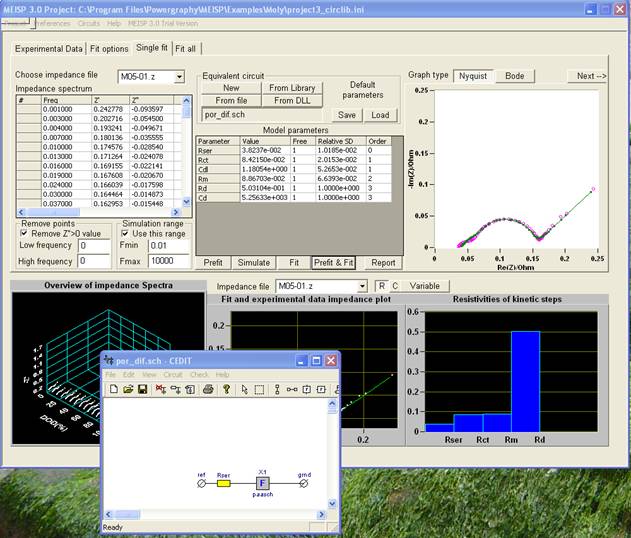
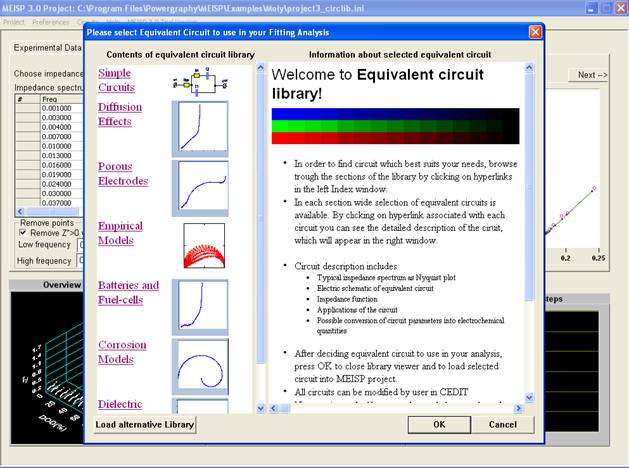
This is a “Multiple EIS parameterization” software that uses LEVM engine for fitting but adds to it ability to analyze multiple spectra together and observe tendencies of parameter changes. It supports automatic pre-fit of initial guesses, which eliminate the need of manual guessing and allows forcing of time-constant order to different elements. Graphical presentation of the spectra, results and parameters is also included. In addition it includes rich library of commonly used equivalent circuits and distributed elements (such as limited length diffusion), that can be included as part of the circuits. There is also a graphical circuit editor that allows to create arbitrary circuits, as well as support of user created models as DLLs.
Here are few example screen-shots. Single fit window:
Circuit library:
Unfortunately
commercial version of this program is no longer available because project was
discontinued.
On the bright side, there was a fully-functional trial version that was freely
distributed (get it here).
So it looks to me that since
commercial version no longer exists, it is a fair game to use the trial version
as long as you want. It appears also that
due to some changes in Windows OS, the expiration mechanism no longer works.
MEISP
works fine in Windows XP. Make sure to unzip installer files into a directory
with short name without blanks (like c:\install), this installer does not like
directories with blanks.
For
1)
This program has very sophisticated help system. For example if you click on a
distributed element in circuit editor, and than F1, you will get detailed
description of the element with literature references, equations and figures.
But, in
2) Due to some additional protections in
No worry, it can be fixed. After
installation, copy the entire folder MEISP
from C:\Program Files\Powergraphy into a directory outside of “Program
Files”, for example “c:\tools”. Start MEISP.exe from there.
Than create an example project in the directory c:\tools\MEISP\examples\Moly
(or some other place, but NOT inside Program Files!). After you add files into
the project, do some fitting and save the project, MEISP will remember this
directory and will not try to write anything into its original folder. Also
make sure to open example files from the new directory where you moved MEISP,
and not from the place under “Program Files”.
Happy Fitting!
- Equivalent Circuit (Dr. Bernard Boukamp)
- apparently not available for download, but you might try to ask author.
- ZSimWin by EChem Software